
Friday, November 22, 2013

Semantic Boolean Analysis of "Resist"

In my previous blog about Rififi, I had initially used the sentence "…I couldn't resist not writing about Rififi." I wondered if I'd made a mistake. Indeed, I had, which I later corrected to "…I couldn't resist writing about Rififi." Using an extra "not" had totally changed the meaning. Here's the Boolean analysis.

  • resist writing => I don't write
  • not resist writing => I write
  • resist not writing => I write
  • not resist not writing => I don't write

"Resist" beautifully takes on the role of the Boolean operand NOT. An even number of NOT operands cancel or negate each other. That is, NOT(NOT(X)) = X

And an odd number of NOT operands function as a single NOT. That is, NOT(NOT(NOT(X))) = NOT(X)

Hence,

  • I couldn't resist not writing = NOT(NOT(NOT(write))) = NOT(write) => I don't write
  • I couldn't resist writing = NOT(NOT(write)) = write => I write

Therefore, I corrected the sentence as I did write about Rififi.

I couldn't resist writing about the semantic Boolean analysis of "Resist!" - Faezal

It is the weak who give into their inner Rififi

Rififi film posterBeing the eternal sloth too impatient to stay glued to the tube for long, I never imagined that I’d be writing about a movie someday. Thanks to one of my best friends, Sonja (Sonia Kumar), whose persistent cajoling drew into me the finer aspects of appreciating movies and good stories, and an apparently not-so-significant-to-the-plot moment from the movie that deeply touched my heart, I couldn’t resist writing about Rififi.

I discovered the movie in a strange way. As is my wont of studying about medicines, I came across Rifampicin while searching potent antibiotics for my chronic acne breakouts. The pharmacists who discovered this antibiotic in the 1950s were fans of Rififi, who they named it after. I further dug into it and found an old print of the French movie with English subtitles.

Glad that I discovered the movie, I could write a book on it, but there’s no point in repeating the tons of its critical appreciation. To begin with, you can get a fair idea about the movie on Wikipedia. Jules Dassin—the director of the movie, who also starred in it as the safe breaker—executed the movie in legendary conditions with a low budget while on the run after getting blacklisted from Hollywood because of some alleged political affiliations (ironic as I thought Hollywood was untouched by petty politics).

Rififi is a classic jewelry heist movie set in Paris, 1955. The brilliance of the plot and its direction lies in the fact that it gets the audience rooting for criminals. Devoid of the typical fanfare of Hollywood movies, the most impactful part of the film is the realism of the heist and its clockwork precision—filmed with no background score or dialogues, briefly rendering it as almost a silent movie. Not only was the movie’s plot of the heist fashioned on a real burglary, it also influenced many a burglar for similar attempts in real life.

The movie excels in portraying the humane aspects of criminals. Behind their tough guise, they are only human with common aspirations for love, wealth and prosperity. That they can be men of character who honor their words, that they can have broken hearts, that they can have loving families for whom they are ready to die for—is all very beautifully depicted in the movie. But most important, the movie depicts how even the perfect heist can get undone by the foibles of humanity.
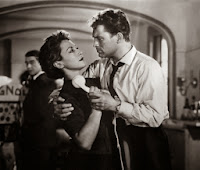
Louise (Janine Darcey) and Jo (Carl Möhner) on hearing the news about their kidnapped son in the film Rififi
Louise (Janine Darcey) and Jo (Carl Möhner)
on hearing the news about their kidnapped son
I will not be a spoilsport and get into the details of the plot, but here’s what I found to be the defining moment of the movie that compelled me to write this blog. After executing the heist, the protagonists get chased by a rival gang. The rival gang kidnaps the son of one of the protagonists, Jo, as ransom for the spoils of the thievery. Jo had reveled in executing the heist, as if it were a game that he played well and won, but he realized what it meant to steal when his son got stolen from him.

The mastermind of the heist, Tony, is the godfather of Jo’s son. He promises to get Jo’s son back. Worriedly awaiting Tony’s phone call about their son, Jo and his wife (Louise) exchange dialogues where Louise blames Jo for their predicament. Louise says to Jo:

  • That his tough demeanor of a gangster was just a guise—a pretense of his underlying weakness.
  • That his friends from his earlier days of poverty were stronger. They were stronger as they could resist giving into their temptations (of committing a crime).

So true! You may have ruled the world, but it all comes to naught if you can’t rule your mind. Controlling the inner demons is the biggest feat. Giving into temptations is the easiest thing one can do. Many a time, we give into temptations and make rash impulsive decisions only to repent later. This insightful dialogue from Louise may not appear to be significant to the overall plot of the movie’s heist theme, but I reckon it to be the most profound truth Rififi brought to the fore using crime as a metaphor.

Lately, I had been thinking of buying an expensive motorcycle at the cost of ignoring some important financial needs of my family. Having deferred the biking plans, I’m sure my future ride will be sweeter—for I have controlled my inner Rififi.

Sigh! :-( The Tiger Explorer will have to wait. - Faezal

Monday, May 20, 2013

Predictive Analytics: I’m getting sick three days from now

While working on a Predictive Analytics case study, I got a bit carried away after reading the honeypotting techniques used by active defense systems, such as Mykonos, that use predictive analytics for thwarting cyber threats well in advance of the actual attack. Reminded me of one of my fave sci-fi movies—Tom Cruise's Minority Report.
Predictive analytics didn't work with my boss!

Armed with all the buzz words, I spiritedly walked up to my boss and asked her for a leave three days from now. When she asked why, I told her: “Based on the consistent rise in my body temperature, I see a clear trend whereby I’ll have fever in excess of 104 degrees Fahrenheit three days henceforth. You see, I’ve used cutting edge predictive analytics algos for the conclusion.”

Pat came her reply, “Based on my predictive analytics, without using any algorithms, you’ll soon be fired if you don’t stop using quirky excuses.”

I didn't get the leave, but her reply sure set my temperature soaring!

At work, to lay off the slumber! - Faezal

Thursday, February 16, 2012

To be acquisitive or not to be: A Dickensian twist to the Shakespearean dilemma

Was just reading an article my dad emailed me about Charles Dickens and his first visit to the U.S. in 1842, how it turned from good to bad, how it brought upon a change of opinion where he felt disappointed and even termed Americans as ‘acquisitive’ by nature. (The details can be read in this BBC article that beautifully illustrates the wavering exchange of opinions between Dickens and the U.S.)

What caught my attention was the term ‘acquisitive.’ Its other forms being ‘acquisition,’ ‘acquiring,’ etc., it clearly connotes to the human want for accumulating possessions, coveting and desiring material goods. Many consider this as the bane of humanity. Even Buddhism, for that matter, advocates the renunciation of all desires as the path to salvation.

What I find most funny is that the very quest for moksha, nirvana, or salvation is acquisitive in nature. At the heart of all things—be it material goods, or concepts such as salvation—lies our pursuit of, or the acquisition of, the elusive happiness.

What's wrong in a beggar's acquisitiveness for a square meal,
What's right in a pundit laboring in salvation's zeal

Neither in a gold digger’s adamancy,
Nor in an ascetic’s pursuit of moksha and his prophecy

Happiness is not to be found in a concept or material thing,
’Tis just a state of being that resides in a man’s heart within

At Hyderabad, after waking from my torpor resulting from an excess of tofu, the vegan paneer. – Faezal, Thursday, February 16, 2012, 19:00

Wednesday, December 7, 2011

Faezal's Fart Theorem and its Boolean Analysis

Never hold a fart. Otherwise, the gas travels up your head and that’s where shitty ideas arise from!*
* The origin of this statement is a mass-forwarded email joke. However, its conversion into a "Theorem" is the genius of Professor Faezal Yunus.

Boolean Analysis of the Theorem: Did the author write this while holding a fart?

Author wrote this while holding a fart
Theorem’s logic
1
0
0
1


Explanation: If the author wrote the theorem while holding a fart, then by the theorem’s admission, the theorem will be considered a shitty theorem (that is, it will negate the very essence of the statement). Therefore, while writing this theorem, the author either evacuated with glee or remained unperturbed by the Sphincter ani.

Hence, proven that the theorem is not shitty at all! 

Yup, canned baked beans got the better of me! - Faezal

Monday, February 14, 2011

The ‘Dog Days’ of my past life, my tryst with women in this life, and hopes for unrelenting love and respect for dogs


Ever since having gained consciousness, I have adored man’s best friend. Dogs, that is. These four-legged furry toys, perpetually winded for a ‘happy ending’ (the wagging tail), are the love of my life. I bet I was a dog in my past life—explains our mutual affinity.

But I must have been a ferocious dog, having bitten many, the bad karma ensuing my reincarnation as a human in this life. So here I am, walking the earth on two legs, making do with the commode instead of the lamppost. Alas! And as if this were not enough, then came women. Well, they are not bad creatures, but my tryst with them has yet to yield a ‘happy ending.’

The first time I came across a pretty girl was when I was in kindergarten. All of us kids would gather around and play catch-ball with each other, just like puppies playing together. Once during playtime, I threw the ball at her and she missed catching it. The ball hit her chin and she got visibly upset, I rushed to say sorry and as soon as I approached her, she said, “Kutte!” Kutte in Hindi means ‘dog,’ so I found it a bit ironic as I wasn’t expecting pleasantries at all. Nonetheless, I felt elated with joy and blushed—it’s not every day that a pretty girl compliments you. She was with me throughout primary grade school and I soon learned the fact that Kutte was not meant to be a compliment, but an expletive! So all of these years, my feeling that she had a crush on me was pure wishful thinking. I was enraged and dumped her from my thoughts immediately—how could someone use the dog analogy in the form of an expletive! This experience hurt me so much that it almost heralded an aversion to women.

I was upset for a while but didn’t let this experience make me stereotype women, after all, I came across many who loved dogs as much as I did. Fast forward a few decades, with countless love affairs with furry four-legged friends, I was in Liverpool, UK, for an official project and came across a pretty Irish colleague. Looking back, she was quite ordinary, but what got me hooked was her amazing cascading hair, especially the color of it—the exact hue of an Irish Setter, a gorgeously exotic reddish copper-brown. I was stunned to see the same color on a woman’s head and couldn’t help but compliment her stating how her hair reminded me of the graceful Irish Setters. To my surprise, the smile on her face dropped dead. I just couldn’t understand as I was hoping she’d get flattered. Only later did I realize that she didn’t like the dog analogy. Immediately, I dumped her from my thoughts, helped further by divinity as I soon saw a pair of Irish Setters being walked nearby—their coat was certainly richer and more graceful than that copper-red-haired colleague of mine.

But not all women get peeved at the association with dogs—one of my lady bosses at work used to drive a Honda Civic with a purple shade that reminded me of the purple-blue coat hues of a Neapolitan Mastiff. I never dared to mention this to her (trepidations of my previous experiences) but I soon got to know that she was an ardent fan of dogs and even had a German Shepherd at home. So one day I casually mentioned how similar the Neapolitan Mastiff’s shade and her car’s color were and she quite sportingly agreed with a smile. I wish all women, and men, were like this.

Analogy/association to dogs has always served a derogatory purpose. Man’s best friend certainly deserves better. I wish everybody starts respecting dogs, aptly described by Lord Byron’s ode to his beloved Newfoundland, Boatswain: “… Who possessed Beauty without Vanity, Strength without Insolence, Courage without Ferocity, And all the virtues of Man without his Vices…

So here’s hoping for the restoration of respect and love for man’s best friend. And how I long for my dog days—I hope my good karma in this life puts me back on four feet in the next one, reveling in being a son of a bitch, leading a dog’s life with a guaranteed ‘happy ending!

(Authored at Hyderabad, February 11 to 12, 2011)

Tuesday, March 3, 2009

Riding the Bullet across the Desert of Life


I recently undertook something I had always wanted to do—a road trip on bike. What a helluva experience it was! Driving a boring car to office since more than four years, I had simply lost this love to the mundane activities of life.

A few things were weighing heavy on my mind so I just jumped at the idea when a friend suggested visiting the Jaisalmer desert festival. Four of us biker friends hired Bullet Enfields and impulsively took off for the trip. The best part being: it was largely unplanned and we often took the road less traveled.

The following text may bore you to death but some of these snaps will amuse you for sure. Our camera was pretty ordinary but some of these snaps are of out-of-this-world beauty—only proves that it is not the equipment but the captured ‘moment’ that matters most.
http://www.flickr.com/photos/32163513@N08/sets/72157614077578698/show/

We covered 2100 kilometres across five days; rode in the early morning with dense fog to late in the cold night on narrow deserted roads with just the moonlight to guide us through and the assurance of the company of our partners via the thump of their bike's exhaust notes. 


Why a bike? Well, how else could we have delved into the smells and sounds of the local villages we passed by—every speck of dust that settled on our glass shades had a unique story to tell. Besides, the wind turbulence trying to sweep us off the bike while riding it at 120 kilometres per hour, or the snail-pace careful maneuvering required to stay afloat on rough terrain, is an experience you just can't relish in a car. The man-machine unison that a motorcycle offers is simply incomparable.

The summit was not the point, the journey was. It taught us so much—lessons about teamwork or averting near-death experiences on the highway—and gave us a lifetime's high with memories that will never fade away. For instance, incidents such as a friend's bike faltering mid-way and how we went into the village searching for a mechanic gave us some bits of irritation but it was real fun and a worthwhile experience.


Then, at Jaisalmer, we got coaxed into trying out "Bhang Lassi" (Bhang: psychoactive cannabis, better known as marijuana) at a government authorized shop (of all the things in the world, government-authorized!) and it hit us after an hour—what an amazing high! It gave us hallucinations and some of us decided to abandon the bikes and return to the hotel. It was one of the most bewildering experiences—we couldn’t walk or think straight but somehow our consciousness had increased ten-folds, though it came with a time lag. I still wanted to ride as it felt as if I was flying but the team's collective wisdom prevailed; I could have been dead had I done so. The next day, our abandoned bikes in the market evoked a bomb scare and we had to face the music with the local police who, ironically, turned out to be quite friendly and cooperative. In short, that's a script for a movie!

The raw Thar Desert’s sand dunes were beautiful and the scenic rocky-sandy mountains were out-of-this-world. Our footsteps in the desert sand got swept away by the light winds in front of our eyes and I realized how insignificant we humans are in front of nature.


We also ventured near the Pakistan border after Sam Village and visited the Ajmer Shariff shrine on our way back. We once were riding late in the evening and the sun was setting in front of the highway; it seemed as if we were riding on a road leading into the sun—the experience was so mesmerizing that we just didn't stop the bikes to take a snap of the engulfing moment.

Looking back, none of our folks agreed in principle (two of my mates conned their folks into believing that they were leaving by train) as they found the idea quite dangerous. But life is too short to not venture out and experience nature's beauty, at least once in a while. For all practical reasons, one could even die after slipping in the bathroom! We could have died on the road but we now can proudly say that we can't die by the bullet as we'd be riding one—quite literally!


I always wanted to ride across the Grand Canyon on a Harley but would I have enjoyed it as much? No! It is company that matters most and had it not been for the camaraderie of the fellow bikers, or Bulleteers, it wouldn’t have been half the fun. Here’s an introduction to the gang.


Photo: Anirban, Anshul, Gaurav, and me (Faezal) lounging at the roof-top cafe of our Jaisalmer motel. The cafe was strangely named "Bob Marley Cafe"!


Anirban Ghosh: The rock star and a maverick entrepreneur who left a hi-fi career to pursue his true calling via starting a music school and production house, Art Tree. It was he who floated and initiated this bike trip’s idea. Anirban, you’re a true inspiration.


Anshul Dabral: A young prodigious creative genius and entrepreneur who runs an enormously successful 3D-modelling creative shop, Paintbox. A true biker who is always ready to leave everything behind and go trippin’ on his thumper. The photos that you see here (see his album's link above for more) are primarily the handiwork of his keen eyes.


Gaurav Chauhan: The only member deeply ensconced into corporate life with a hi-fi stature and position. Yet, he still finds the time to venture out on exciting expeditions. “What good is money if you can’t even enjoy life with it” is his philosophy in life. Gaurav, it’s good to know that men tied up in business suits are not all that boring.


Yes, let us not forget the purpose of the daily grind to earn our livelihoods; at times we get so consumed by life’s mundane affairs that we don’t even find the time to reflect and introspect on our own lives. This bike trip was one of the best things I have done in this life so far and we are already planning our next trip to Leh-Laddakh. Perhaps the snaps in the link above will evoke some interest so I invite all of you who read this to join me as a pillion or a rider alongside, riding the Bullet.


As an after-thought, such trips are the least about the thrills of speed or the excitement of venturing into unexplored territories; they are a reflection upon nature and life itself. And unlike the sands of time that will one day sweep away our existence, such experiences leave indelible memories to last a lifetime.